How Much Does a Metal Roof Cost in California in 2026?
By David Hahne / Will Schmidt • May 20, 2026
Summary of Metal Roofing Costs in CA in 2026
Metal roofing has surged in popularity across California thanks to its durability, fire resistance, and clean, modern aesthetics. Homeowners considering a new roof in 2026 need to know what drives costs in the Golden State. Prices fluctuate widely depending on the panel system, metal thickness, regional labor rates, and the complexity of your roof. This guide breaks down the latest cost data for California and explains how to budget confidently for a standing‑seam or corrugated metal roof.
2026 Metal Roofing Costs at a Glance
A full-metal-roof replacement in California costs
$7 to $35 per square foot installed. Most projects fall between
$14,000 and $50,000, with Bay Area and Los Angeles homes on the higher end of that range. By comparison, national averages range from
$7 to $30 per square foot, so California does carry a premium. The table below summarizes typical installed costs per square foot for common systems in California:
| Metal roof system | Installed cost per sq. ft. | Typical lifespan | Best for |
|---|---|---|---|
| Corrugated metal (exposed fastener) | $7 – $12 | 30–45 years | Budget projects, accessory dwelling units (ADUs), sheds |
| Stone‑coated steel | $8 – $15 | 40–70 years | Traditional look with metal durability |
| Metal shingles | $8 – $15 | 40–70 years | Shingle appearance with metal performance |
| Aluminum (standing seam) | $8 – $15 | 40–70 years | Coastal homes and corrosion resistance |
| Steel (standing seam) | $10 – $16 | 40–70 years | Premium residential systems |
| Zinc | $10 – $20 | 50–100 years | High‑end modern designs |
| Copper | $15 – $30+ | 70–100+ years | Luxury and architectural statements |
Choosing the Right Panel System & Metal
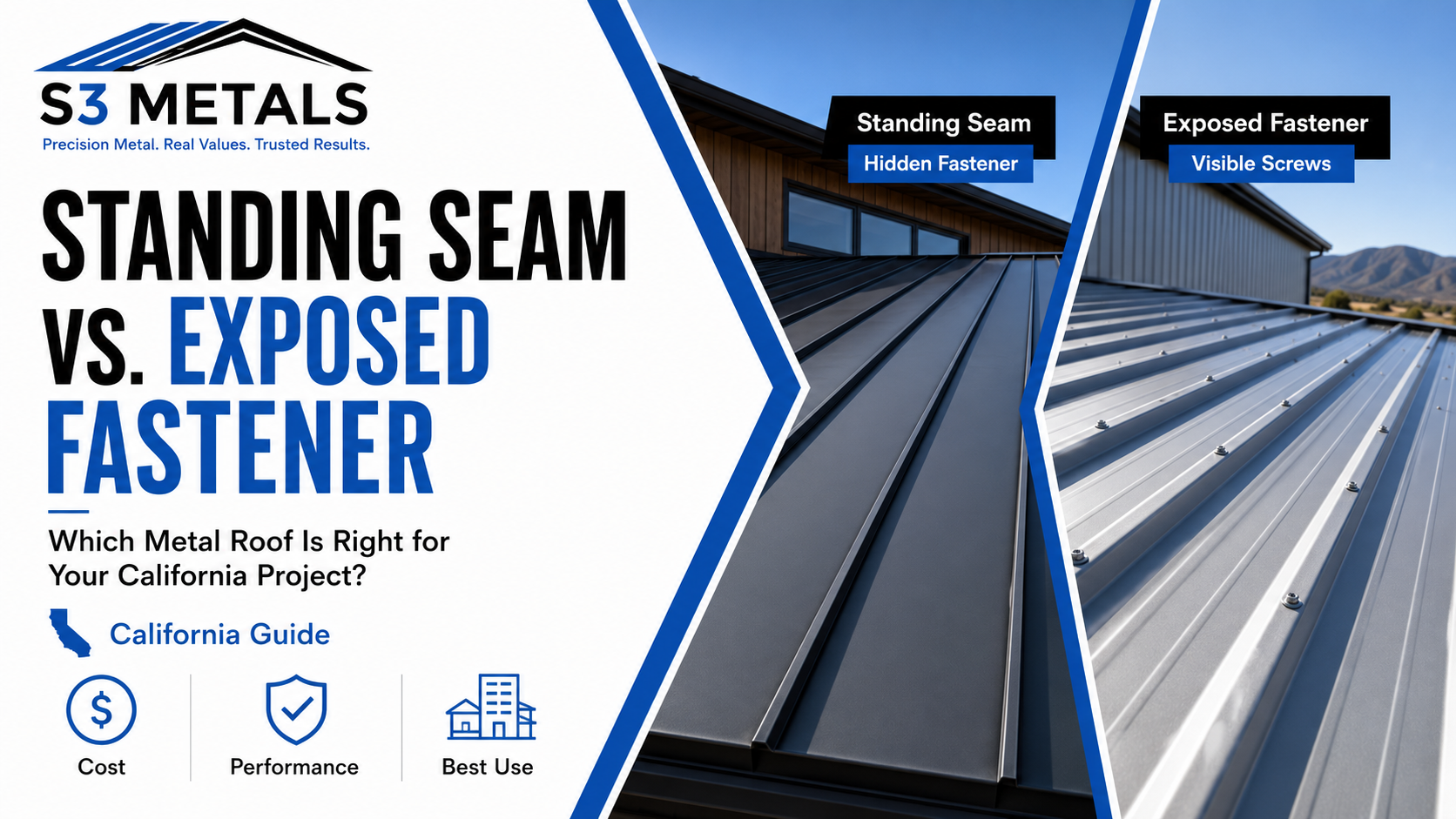
The panel system and metal type you choose have the largest impact on cost. Corrugated metal uses exposed fasteners and is the most economical option at about $7–$12 per square foot installed. While budget‑friendly, exposed fasteners require periodic re‑sealing every 10–15 years, so long‑term maintenance should be considered.
Stone‑coated steel and metal shingles deliver a traditional shingle or tile look with the performance of metal. Both systems cost roughly $8–$15 per square foot installed and last 40–70 years. They are popular in California neighborhoods with homeowners’ association (HOA) design rules because the textured surface satisfies aesthetic requirements while still providing a Class A fire rating and long service life.
Standing‑seam panels are the gold standard for residential metal roofing. They hide the fasteners beneath raised seams, eliminating leak points and allowing thermal expansion and contraction. Steel standing‑seam roofs run $10–$16 per square foot installed; Bay Area projects on a 20‑square (2,000 sq. ft.) roof typically cost $20,000–$32,000. Aluminum standing‑seam roofs cost $8–$15 per square foot and are ideal for coastal regions where salt air makes steel’s corrosion resistance less reliable. Premium metals like zinc and copper push costs to $10–$20 and $15–$30+ per square foot, respectively, but they deliver 50–100+ years of service and striking architectural character.
When evaluating quotes, be sure to compare the exact panel profile, metal thickness (gauge) and paint system. Budget corrugated systems often use thinner gauges and lower‑grade SMP coatings, while premium standing‑seam roofs come with thicker steel and PVDF finishes for better UV and corrosion resistance.
Metal Roofing Gauge Matters: 26 vs 24 vs 22
Metal thickness is measured in gauge—the lower the number, the thicker (and more expensive) the material. The industry standard for high‑end residential roofs is 24‑gauge steel. It offers good rigidity and resistance to “oil canning” (a wavy appearance) and usually comes with superior PVDF coatings. 26‑gauge steel is thinner and about 10 % cheaper to install; it remains more durable than asphalt shingles but is more prone to denting and typically uses lower‑grade SMP coatings. RoofSmart notes that 26‑gauge installation saves roughly $6,000 on a hypothetical $66,000 metal roof—a difference of about 10 %.
For extreme conditions—such as hail‑prone mountains or commercial buildings—22‑gauge steel provides maximum rigidity. It is significantly thicker and more expensive than 24‑gauge, so it’s typically reserved for specialized projects. When reviewing quotes, ask suppliers to specify the gauge and coating type, as thinner panels with inferior paint systems may lower upfront costs but reduce longevity and color stability.
Installation & Component Costs
Labor is a major portion of every metal‑roof budget. Nationally,
materials account for $3–$15 per square foot, while
installation labor adds $4–$15 per square foot. That means labor often represents 40–60 % of the total project. The table below summarizes typical 2026 installation components and their cost ranges:
| Component | Typical cost range | What it covers |
|---|---|---|
| Labor (installation) | $4 – $15 per sq. ft. | Skilled labor to measure, cut, install fasteners, fit flashing and complete the roof system |
| Old roof tear‑off | $1 – $3 per sq. ft. | Removing existing shingles or panels and disposing of debris |
| Underlayment | $0.50 – $2 per sq. ft. | Synthetic or high‑temperature underlayment required beneath metal roofing systems |
| Decking repairs | $200 – $1,200+ | Replacing damaged or rotted wood sheathing uncovered during tear‑off |
| Flashing, trim & edging | $500 – $3,000 | Ridge caps, valleys, drip edges, chimney and vent flashing |
| Fasteners & hardware | $300 – $1,000 | Screws, clips and specialty fasteners |
| Ventilation adjustments | $300 – $1,200 | Adding or upgrading ridge vents, attic vents and other ventilation components |
| Waste, cutting & customization | 5 – 20 % of total cost | Extra material, custom cuts and intricate detailing, especially on complex roofs |
Resources:
Jag Metals LLC
Complex roofs with multiple valleys, dormers or steep slopes require more labor time and custom trim pieces, pushing costs toward the upper end of these ranges. When comparing bids, ensure contractors include all these components so you aren’t surprised by change orders later.
Freight & Labor Rates in California
California’s labor market is among the most expensive in the U.S. Licensed roofing crews typically charge $60–$80 per hour, and labor accounts for 50–60 % of the total metal‑roof cost. Standing‑seam installations also take longer than asphalt shingles; a 2,000 sq. ft. metal roof usually requires 4–7 days, compared with 1–3 days for asphalt. Regions with a higher cost of living—such as the Bay Area and Los Angeles—see the highest labor rates. Delivery fees also add to the final bill, especially for remote sites or custom on‑site roll forming. Ask suppliers whether panel fabrication occurs locally or will require freight from out of state.
Additional Factors & Regional Variations
Beyond the basics, several factors can push your quote above or below the average:
- Roof size and complexity: Larger roofs cost more in total, though economies of scale may reduce the per‑square‑foot rate. Steeper pitches, multiple levels, and intricate rooflines increase labor time.
- Removal of the old roof: Skipping the tear‑off (if local codes allow metal over a single layer of shingles) can save $1–$3 per square foot.
- Wildfire & coastal requirements: Homes in fire‑prone zones may need thicker panels, specialized underlayments, and class A assemblies, while coastal homes often require aluminum or zinc to resist salt corrosion.
- Regional pricing: In San Francisco, Angi data shows metal‑roof installation averaging $19,978, with projects ranging from $6,225 to $38,316 depending on metal type and complexity. Bay Area projects often exceed $30 per square foot, while inland areas may fall closer to $10–$20 per square foot.
- Energy‑efficient coatings & solar: Upgrades such as high‑performance PVDF coatings, reflective pigments, and integrated solar attachments raise upfront costs but can lower cooling bills and qualify for tax credits. California’s growing solar market makes standing‑seam roofs especially attractive because the concealed‑fastener design allows PV racking to be easily attached without roof penetrations.
Conclusion: Budget for Value and Longevity
While a metal roof in California requires a larger upfront investment than asphalt shingles, it delivers a 40–70+ year lifespan and superior fire and wind resistance. For most homeowners, installed costs range from $7 to $35 per square foot, or $14,000–$50,000 on a mid‑size home. Corrugated systems offer the lowest entry point, standing‑seam steel strikes a balance between performance and price, and premium metals like zinc and copper provide unrivaled longevity and curb appeal. Choosing the right gauge and panel system, understanding the labor and component costs and working with an experienced local contractor will help you get the best value for your budget.
Quick Takeaways
- Budget range: Expect $7–$35 per sq. ft. installed in California.
- Panel choice: Corrugated systems are cheapest; standing‑seam aluminum/steel is most popular; zinc and copper are premium.
- Gauge selection: 24‑gauge is standard; 26‑gauge saves ~10 % but is thinner; 22‑gauge is reserved for extreme conditions.
- Labor share: Installation and tear‑off make up 40–60 % of the bill.
- Regional impact: Bay Area projects often exceed $30 per sq. ft., while projects in inland regions may be closer to $10–$20 per sq. ft.
Latest Posts